
























Natalia Bracikowska
-
Dec 22, 2025
-
5 min read
Until recently, online shopping worked in two pretty predictable ways: you either Googled what you wanted using a few keywords, or you went straight to a site you already trusted to find suitable products. Either way, you most likely ended up on comparison sites to check prices and read reviews, and selected the best option in terms of price, delivery, and store’s reliability [1].
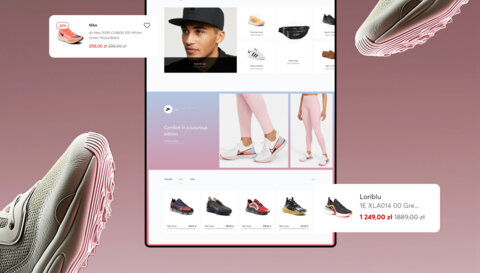
This behavior shaped how e-commerce sites were built for the last two decades. It prioritized keyword SEO, polished product pages, and design patterns that encouraged picking up a few extra items along the way. In other words, the brands that dominated Google search, invested in slick on-site UX, and showcased products with strong visual merchandising were usually the winners. But that’s starting to change.
ChatGPT is becoming a new shopping tool
AI chatbots, particularly ChatGPT, are increasingly being used as alternatives to traditional search engines. A recent Adobe survey found that 77% of U.S. users who engage with ChatGPT consider it a search engine, with nearly 34% of prompts being related to product searches [2]. This means that one in three ChatGPT queries is someone shopping.
It’s easy to see why: AI is fast, efficient, and does a lot of the heavy lifting for us. Instead of spending hours hopping between multiple browser tabs, we can get consolidated recommendations in just minutes. For now, that convenience does comes with occasional hiccups - like ChatGPT recommending products that don’t exist, getting some specs wrong, or misquoting prices - but for most users, this is a small price to pay for skipping the tedious research grind.
Changing query structure
The change isn’t just about where people search, but also about how they search. Instead of short, keyword-focused queries like “best running shoes under $150,” users are more likely to type something like this: I’m a 32-year-old runner with mild knee pain, looking for running shoes under $150 that offer good support for my joints.
The second query provides a lot more contextual information [3], which fundamentally changes what gets recommended and, ultimately, what gets bought.
This shift isn’t merely linguistic - it marks a move from manual browsing to personalized guidance. Rather than scanning pages of results and comparing specs manually, users are offloading all that work to AI systems, much as they might rely on a knowledgeable assistant in a physical store.

Generative Engine Optimization
For online retailers, this introduces a new visibility dynamic. Beyond competing for traditional Google search rankings, brands now need to be seen by AI systems parsing product data and matching it to conversational queries.
This is where Generative Engine Optimization, or GEO, comes in. GEO focuses on structuring product information so that AI can easily understand, retrieve, and surface in response to user questions. This means organizing specifications in tables or lists, including Q&A sections that address typical user questions, and writing useful descriptions that clearly highlight features, benefits, and use cases.
Why not just rely on traditional SEO? AI bots can use SEO to some extent, but metadata optimized for SEO doesn’t always translate well into AI recommendations. Also, as GEO gains traction and more sites adapt to how AI parses e-commerce content, products relying on SEO won’t just be ranked lower - they simply won’t be considered at all, since there won’t be enough meaningful data for the model to match to the user’s query.
Agentic commerce in early testing
All of this leads to a step beyond conversational search: agentic commerce. Let’s imagine that you wrote the following prompt: “Find me a mid-range, automatic coffee machine with a grinder that fits under my cabinets and can be delivered this week.”
In this scenario, the AI agent would identify options, verify specifications against constraints, check delivery timelines, and if approved, process the entire checkout for you. No product page visits. No traditional storefront interaction.
Industry leaders view agentic commerce as an imminent disruption in retail. McKinsey’s research has already documented companies piloting such systems [4], and though the technology remains in an early stage (with success depending on customer trust, regulatory frameworks, and technical standardization), the necessary infrastructure is already underway.
What this means for UX e-commerce
The core ecosystem of Google searches, direct traffic, and traditional browsing isn’t disappearing anytime soon. But AI-driven shopping is adding new requirements, new content patterns, and new expectations for how information should be delivered.
So the real question becomes: do teams start adapting now, or wait until things become a bit more mainstream? A good starting point is to:
Consider the kinds of context-rich questions people are likely to ask AI agents
Shape product descriptions and metadata so they’re clear and useful to both humans and AI systems
Watch how AI tools interpret and recommend your products, and refine your content or interaction patterns based on what you learn
The very structure of e-commerce is beginning to shift. Traditional browsing and on-site shopping will still matter, but it’ll increasingly sit alongside AI-mediated purchases, where the “storefront” may no longer be a website at all, but a trusted AI agent helping buyers along the way.
Sources
[1] "Shopping smarter – How global consumers use price comparison websites," https://yougov.com/articles/46956-shopping-smarter-how-global-consumers-use-price-comparison-websites?utm_source=chatgpt.com
[2] "How ChatGPT is changing the way we search," https://www.adobe.com/express/learn/blog/chatgpt-as-a-search-engine?utm_source=chatgpt.com
[3] "A Survey of Conversational Search," https://dl.acm.org/doi/10.1145/3759453
[4] "The agentic commerce opportunity: How AI agents are ushering in a new era for consumers and merchants," https://www.mckinsey.com/capabilities/quantumblack/our-insights/the-agentic-commerce-opportunity-how-ai-agents-are-ushering-in-a-new-era-for-consumers-and-merchants?utm_source=chatgpt.com


